
Commonly utilised by high-net-worth families, private individuals and non-profit organisations for the following purposes:
- Lawful wealth accumulation, preservation, and management Succession planning and orderly transfer of assets
- Asset protection
- Enhanced confidentiality
- Asset consolidation, centralised administration and management
- Structured pooled family investment planning and family governance planning
- Alternative planning mechanisms for forced heirship or mandatory succession regimes
SIMILARITIES BETWEEN LABUAN FOUNDATION AND LABUAN TRUST
- Assets may be settled, endowed and donated into both structures
- Structure may be revocable
- Structure may be established during the lifetime or upon death of the patriarch or matriarch
- Structure may be established with perpetual or indefinite duration
- Has the option to appoint Protector or Enforcer
- Structured for pooled family investment planning and family governance planning
- No statutory minimum requirement in respect of initial endowment, settlement amount, or value of assets to be contributed
- Structure can be established for any lawful purpose
DIFFERENCES BETWEEN LABUAN FOUNDATION AND LABUAN TRUST
TRUSTS | FOUNDATIONS |
Common law origins | Civil law origins |
Legal relationship | Separate legal entity with its own identity |
Assets, upon being vested in the trust, are legally owned by trustee
| Assets are legally owned by the foundation. Upon registration of the foundation, the property endowed no longer belong to the founder, but belong to the foundation |
Relationship amongst parties is fiduciary | Relationship amongst parties is contractual |
• The person(s) who establishes the trust is known as the settlor • The persons who benefit from the trust are known as beneficiaries | • The person(s) who creates the endowment is known as the founder • The persons who benefit from the endowment are known as the beneficiaries |
Optional to register trust | Mandatory to register foundation |
Trust deed is the document that establishes the trust
| Charter is the main constituent document of a foundation. A foundation may also have articles with detailed rules governing its administration matters |
The appointed trustee is the person responsible to hold and legally own the trust assets and administer the trust arrangement
| The Officer is entrusted to carry on the daily business and affairs of the foundation and pursue its objects. The foundation can also appoint a body called council to supervise the Officers. Both Officers and Council are required to act in accordance with the terms of the charter and articles |
Settlor may have certain reserved powers after constituting the trust and vesting the legal title of the trust assets to the trustee | The founder does not retain or acquire any ownership rights in relation to the foundation’s property. Beneficiaries or the persons named as beneficiary (may include the founder) can receive distribution from the foundation |
KEY PARTIES – LABUAN FOUNDATION
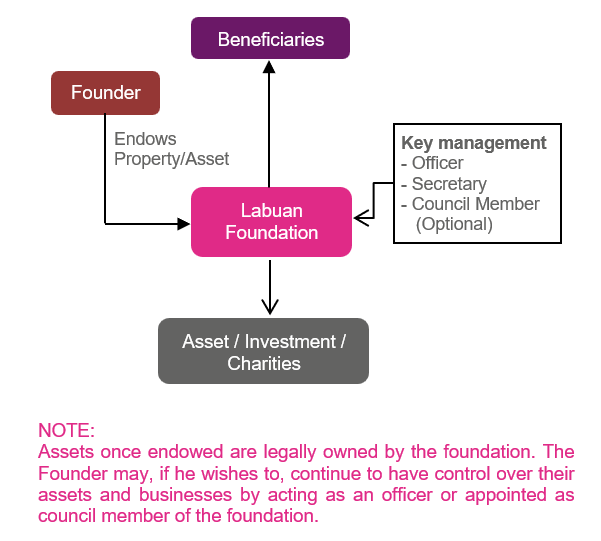
- Founder – Establish the foundation. May be either natural person or corporate and subscriber to the Charter
- Beneficiaries – Persons who have vested interest in assets of the foundation
- Officer – Administers the Foundation to achieve its purpose
- Council - Oversight role for administration of the Foundation
KEY PARTIES – LABUAN TRUST
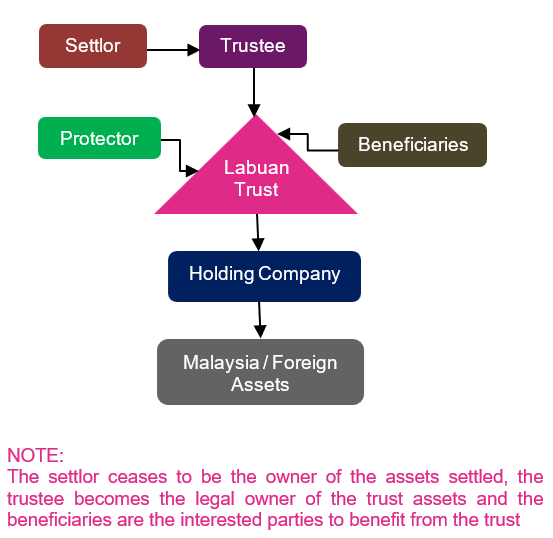
- Settlor – Creates the trust by settling assets into a trust. Settlor may be an individual person or a corporate entity
- Trustee – Holds and legally own the trust assets and is responsible for its administration for benefit of the beneficiaries
- Trust Deed – Central governing document and sets out trustee’s powers (among other things). Settlor is able to tailor the terms of the trust to satisfy their requirements
- Protector/Enforcer – May be appointed by settlor, who acts like a “watchdog” over the trustee for the benefit of the beneficiaries
- Beneficiaries – Persons legally entitled to enforce and benefit from the trust. Can be individual or reference to a class, charities, minors, corporations etc.
LACK OF PLANNING – CONSEQUENCES
- High legal costs and long probate process
- Inaccessibility of assets due to prolonged legal process
- Family dispute and breakdown
- Family business disruption
- Negative publicity
- Tax exposure in certain jurisdictions